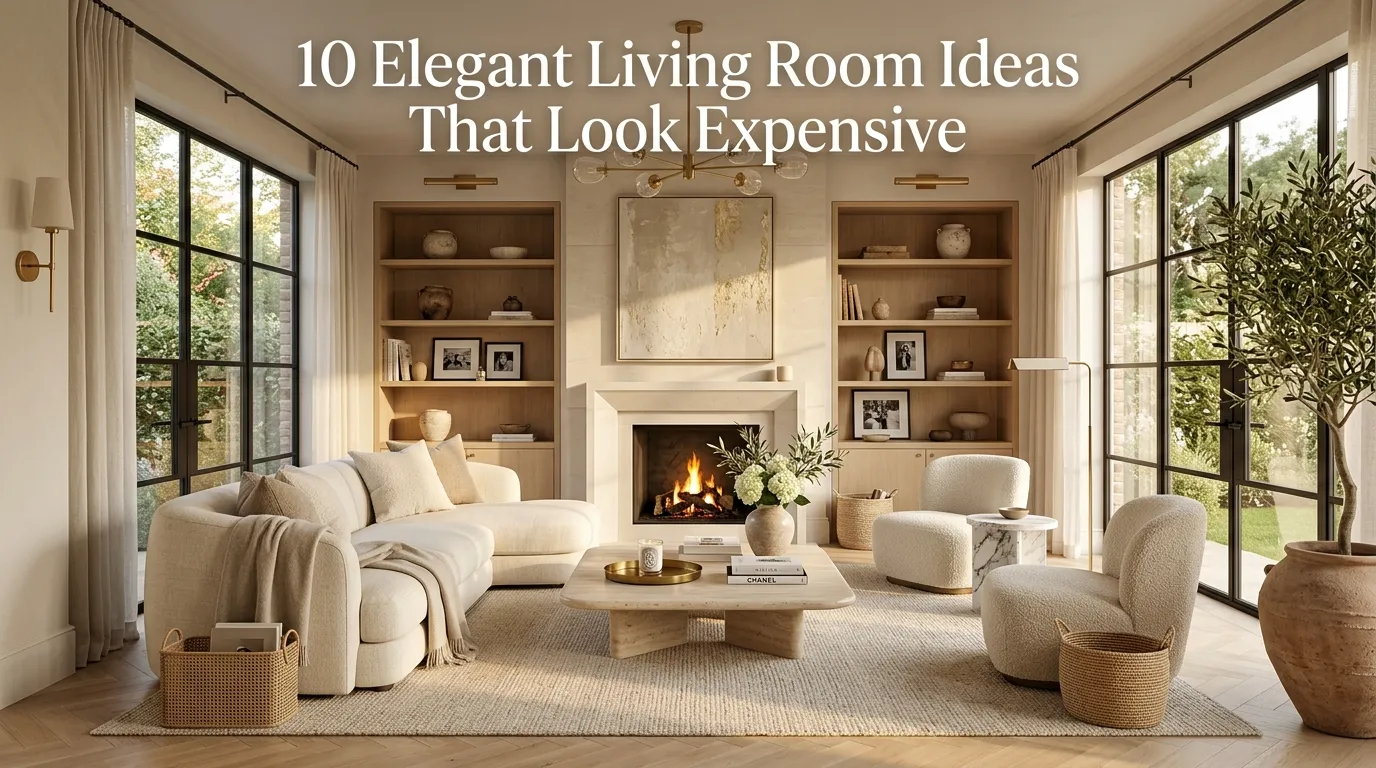
10 Elegant Living Room Ideas That Look Expensive
There’s a specific feeling you get walking into certain living rooms — nothing about them screams “designer,” yet everything feels polished, considered, and undeniably elevated. It’s rarely the price tag that creates that impression. In my experience, the living rooms that read as expensive almost always come down to a handful of deliberate choices, not a bigger budget.
I’ve noticed that homeowners often assume an elegant, high-end look requires custom furniture or a full renovation. A mistake many homeowners make is spending heavily on one big-ticket item while ignoring the smaller details — lighting, texture, symmetry — that actually signal quality to the eye. A single luxury sofa in an otherwise disorganized room won’t read as expensive. A modest sofa in a well-balanced, thoughtfully textured room often will.
That’s why many designers recommend focusing on the details that create a sense of intention: tonal color palettes, rich textures, and a few well-placed statement pieces rather than an overwhelming amount of furniture. These are the same principles used in high-end interior design, just scaled to work in real homes with real budgets.
This guide covers ten elegant living room ideas that consistently make a space feel more expensive, without requiring an expensive renovation to achieve it. From layered neutral palettes to symmetrical furniture arrangements and the right lighting choices, each idea below focuses on the details that separate a “nice” living room from one that feels genuinely refined. Whether you’re updating a rental or reworking a room you’ve lived in for years, these are changes you can make gradually and still see a noticeable shift in how the space feels.
Table of Contents
- Tonal Layered Neutrals — Building a cohesive color story instead of scattered accent colors.
- Statement Marble Accents — Introducing marble or marble-look surfaces for instant polish.
- Oversized Wall Art — Using scale to create a gallery-like focal point.
- Rich Velvet Textures — Adding depth and softness through luxurious fabric choices.
- Symmetrical Furniture Arrangement — Creating visual balance the way high-end spaces do.
- Brass Metallic Details — Layering in warm metal accents for a refined finish.
- High-Pile Area Rugs — Choosing rug texture and quality over pattern alone.
- Sculptural Coffee Table — Letting a single furniture piece double as art.
- Floor-To-Ceiling Drapery — Using drapery height to elevate ceiling and window presence.
- Curated Bookshelf Styling — Styling shelves the way a design showroom would.
1. Tonal Layered Neutrals
Quick Benefits
- Creates a cohesive, high-end color story
- Works with almost any furniture already owned
- Prevents a room from feeling busy or mismatched
- Photographs beautifully in natural light
- Adaptable to warm or cool undertones
Why It Works
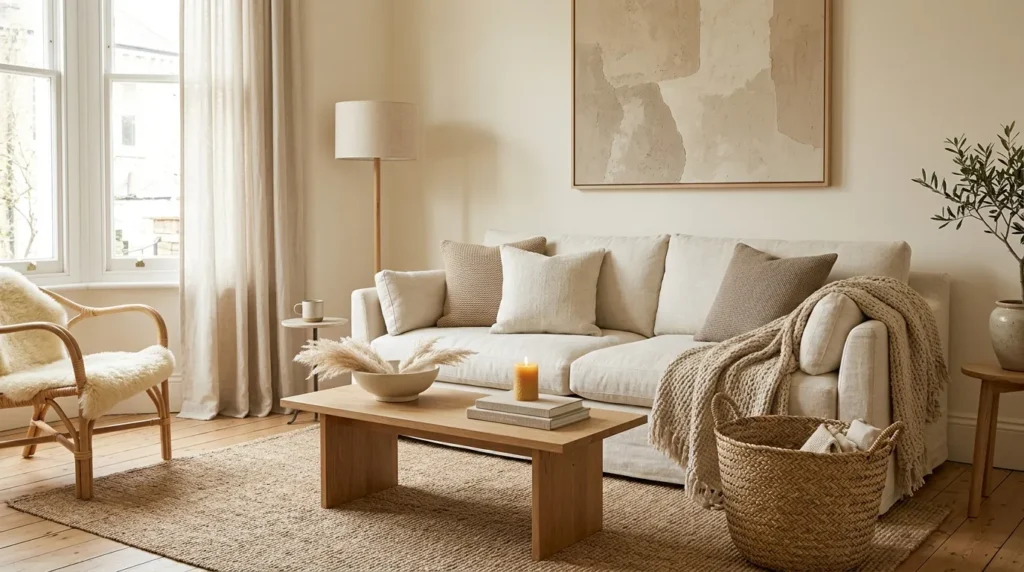
One thing that works especially well in elevated living rooms is resisting the urge to add too many accent colors. Instead, designers lean on tonal layering — several shades within the same color family, like cream, sand, and warm taupe, rather than scattered pops of unrelated color. This works because it mimics how high-end showrooms are styled: cohesive, restrained, and intentional. A room with five different accent colors reads as busy no matter the furniture quality, while a tonal palette reads as curated even with modest pieces.
How To Style It
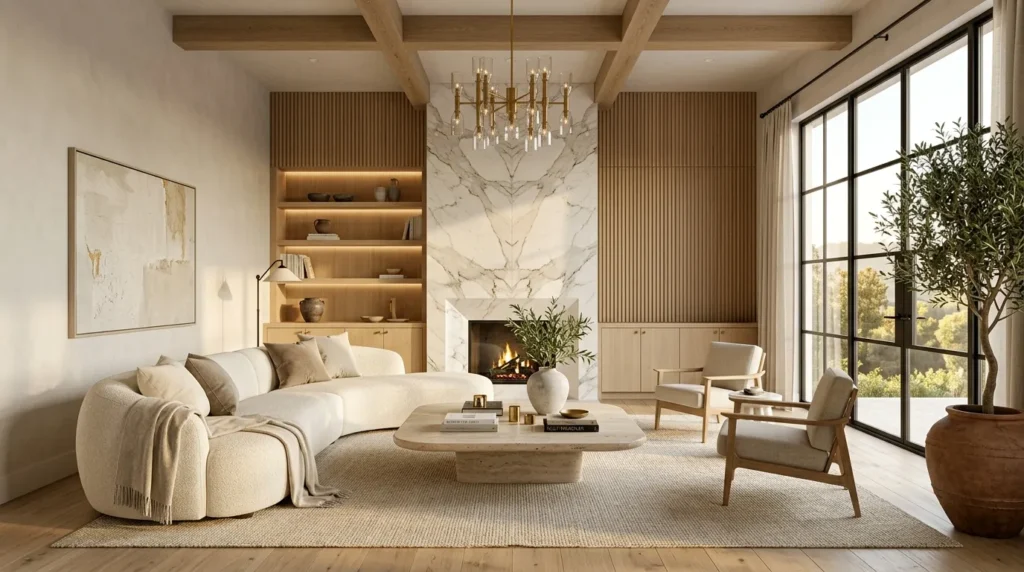
Choose one neutral color family — warm beige tones, cool greige, or soft greiges with a hint of pink — and stay within two or three shades of it across walls, upholstery, and textiles. Add depth through texture rather than additional colors: a nubby wool throw, a smooth linen cushion, a woven basket. Reserve any bolder color for a single small accent, like one piece of art or a candle.
2. Statement Marble Accents
Quick Benefits
- Adds instant visual polish to any room
- Works well in both traditional and modern spaces
- Available in budget-friendly marble-look materials
- Elevates smaller accessories, not just furniture
- Pairs naturally with brass and neutral palettes
Why It Works
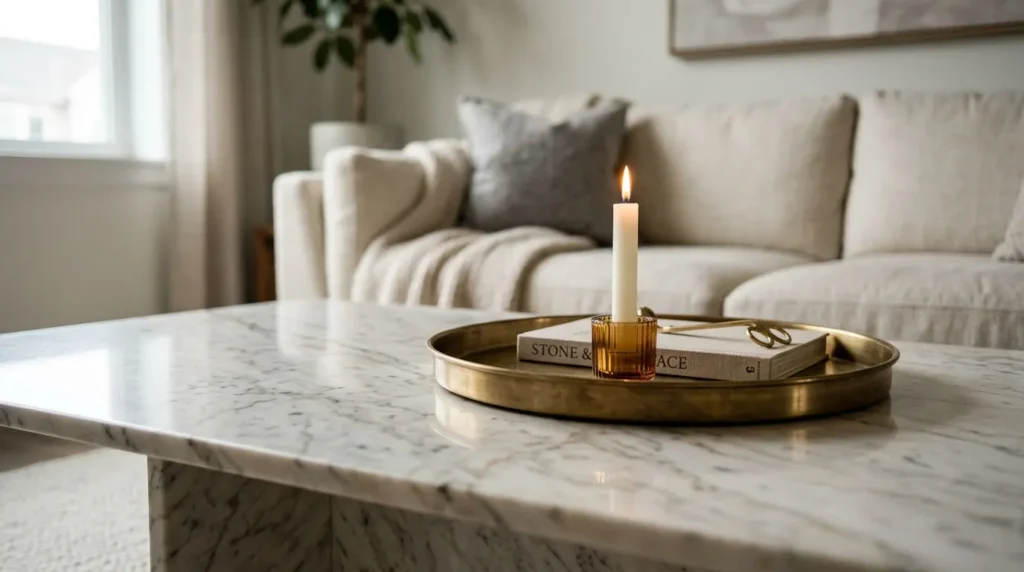
A mistake many homeowners make is assuming marble only belongs in kitchens or bathrooms, but a marble or marble-look coffee table, side table, or tray brings the same sense of quality into the living room. In my experience, marble reads as expensive because of its natural veining and cool, reflective surface — qualities that are difficult to fake convincingly, which is exactly why genuine or high-quality marble-look pieces carry so much visual weight even in small doses.
How To Style It
A marble-top coffee table or a set of marble side tables makes the biggest impact, but smaller touches — a marble tray on a console, a marble-based lamp — achieve a similar effect at a lower cost. Pair marble with warm metals like brass or gold for a classic, elevated combination, and keep surrounding textiles simple so the marble surface stands out rather than competing with heavy patterns.
3. Oversized Wall Art
Quick Benefits
- Fills large walls with a single confident statement
- Reads as intentional rather than an afterthought
- Reduces the need for multiple smaller pieces
- Creates a strong photographic focal point
- Works in both traditional and contemporary rooms
Why It Works
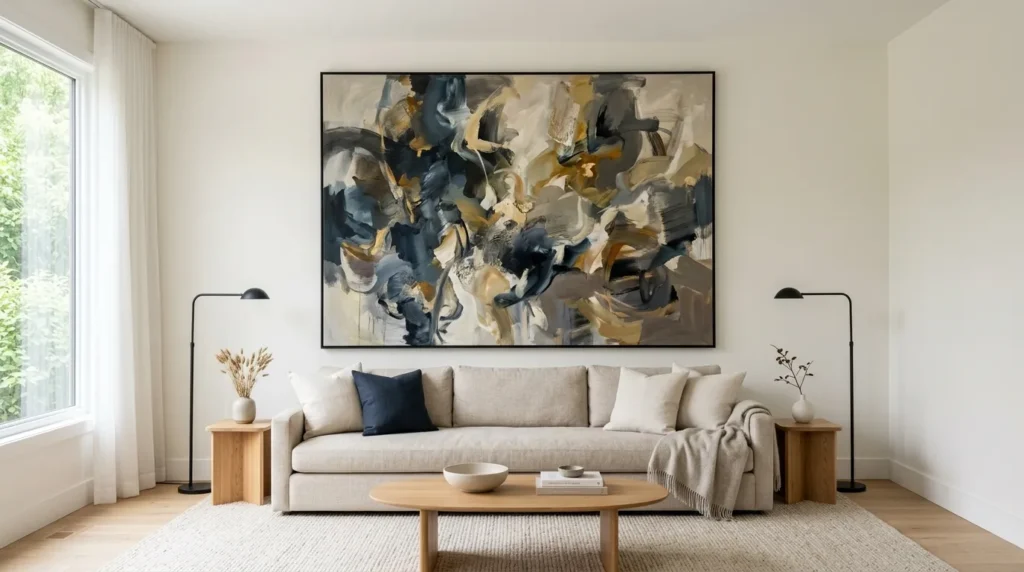
One simple trick I always suggest for an elevated look is going bigger than feels comfortable with wall art. A single oversized piece — much larger than most people initially choose — reads as a deliberate design statement, the way art is scaled in higher-end interiors and galleries. Smaller art scattered across a large wall, by contrast, often reads as unfinished or mismatched, no matter how nice each individual piece is.
How To Style It
As a general guideline, wall art above a sofa should span roughly two-thirds of the sofa’s width. Choose one large-scale piece rather than several smaller ones for the main wall, and keep the frame simple — thin black, brass, or natural wood — so the artwork itself remains the focus. A single oversized abstract or landscape piece often has more visual impact than an entire gallery wall in a formal living room.
4. Rich Velvet Textures
Quick Benefits
- Adds softness and depth instantly
- Elevates even simple furniture silhouettes
- Reflects light in a way flat fabrics don’t
- Works well as an accent rather than full commitment
- Pairs beautifully with neutral, tonal palettes
Why It Works
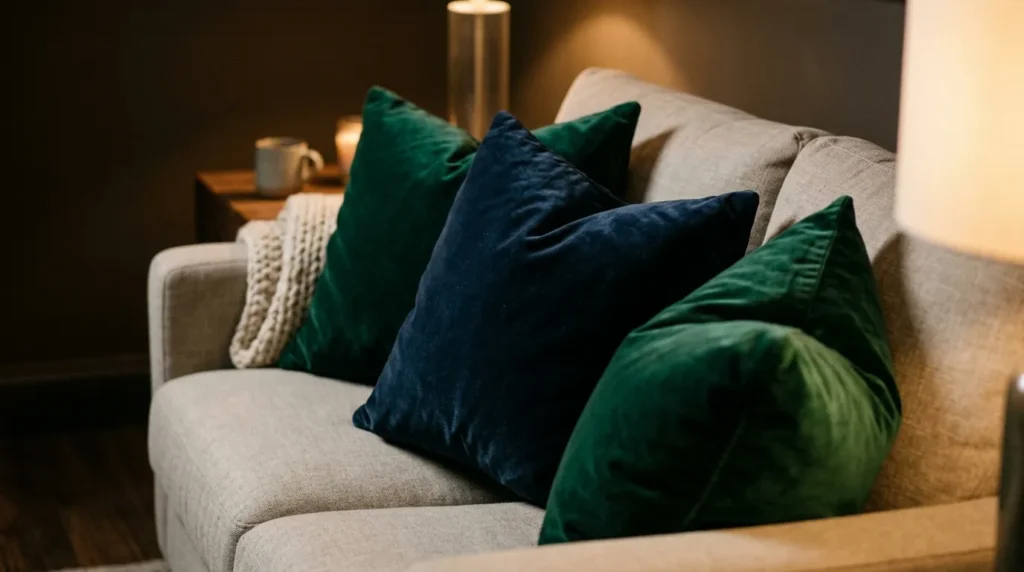
That’s why many designers recommend velvet as one of the fastest ways to make a room feel more luxurious without a full furniture overhaul. Velvet catches and reflects light differently than cotton or linen, creating subtle shifts in tone across a single piece that read as rich and dimensional. I’ve seen this idea transform spaces simply by swapping a few flat cotton throw pillows for velvet ones in a matching or tonal color.
How To Style It
If a full velvet sofa isn’t in the budget, start with velvet throw pillows, a velvet ottoman, or a single velvet accent chair. Stick to deep, muted tones — emerald, ink blue, warm terracotta — rather than bright shades, since deeper colors read as more elegant in velvet’s reflective texture. Balance velvet’s richness with simpler, matte-finish materials elsewhere in the room so it doesn’t feel overdone.
5. Symmetrical Furniture Arrangement
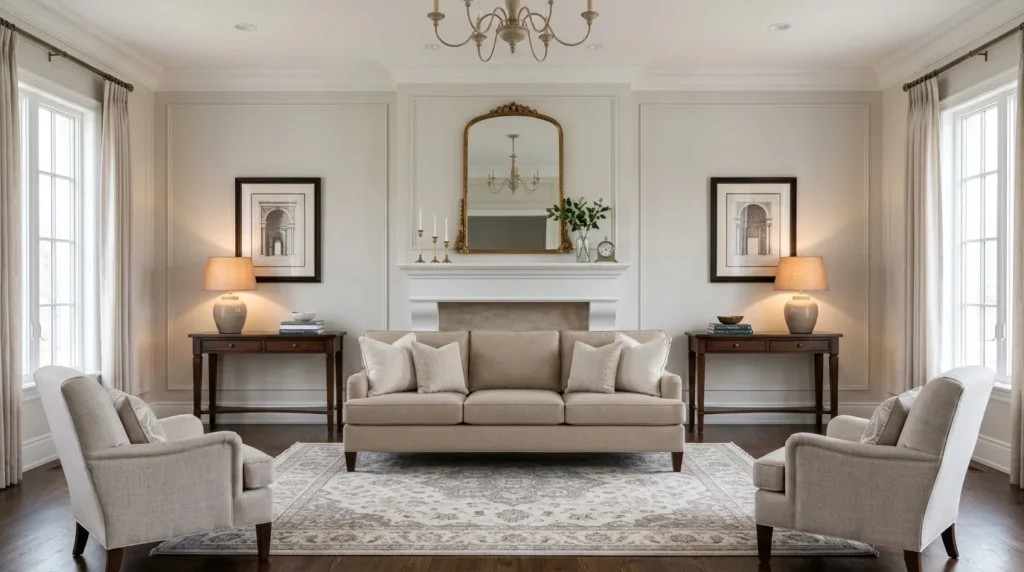
Quick Benefits
- Creates immediate visual balance and calm
- Mimics professional design showroom layouts
- Works well in formal and semi-formal living rooms
- Makes a room feel more finished, not staged
- Simple to apply with existing furniture
Why It Works
A mistake many homeowners make is arranging furniture asymmetrically out of convenience — one lamp on only one side table, mismatched chairs flanking a sofa. In my experience, symmetry is one of the most underrated tools for making a room feel polished, because the eye reads balanced arrangements as more intentional and higher-end, even when the furniture itself is affordable. This is a principle borrowed directly from traditional formal design, where mirrored layouts have always signaled refinement.
How To Style It
Where possible, flank a sofa with two matching side tables and matching lamps rather than one of each. Center furniture around a clear focal point, like a fireplace or media console, rather than pushing pieces unevenly to one side. Even in asymmetrical rooms, small symmetrical groupings — a pair of chairs, a pair of vases — can introduce the same sense of order.
6. Brass Metallic Details
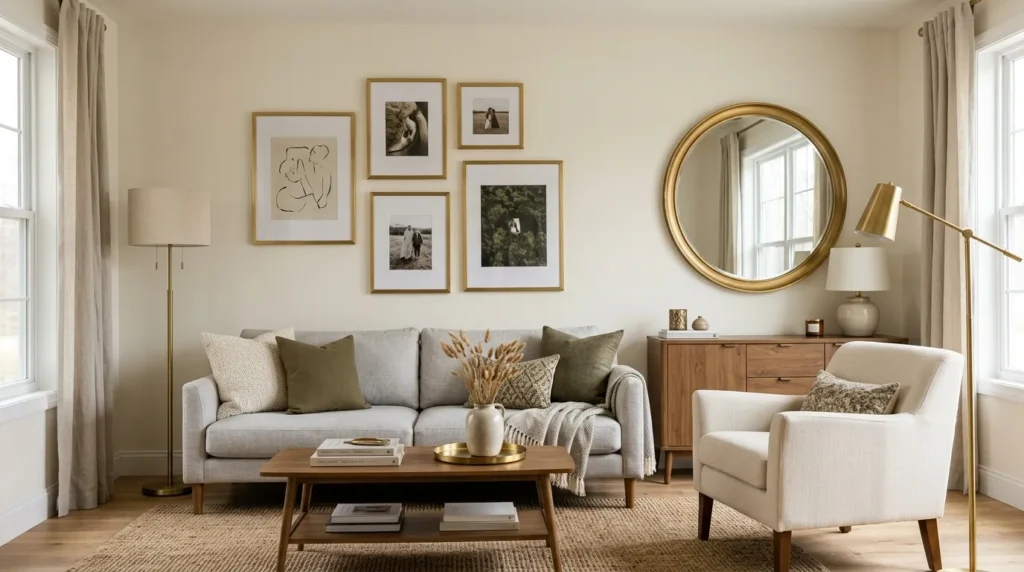
Quick Benefits
- Adds warmth and shine without overwhelming a room
- Pairs well with almost every neutral palette
- Works through small accents or larger fixtures
- Signals quality through finish and material choice
- Easy to introduce gradually over time
Why It Works
A room with mismatched or dated metal finishes rarely feels elevated, regardless of the furniture quality. One thing that works especially well is committing to a single warm metal — brass, antique gold, or aged bronze — across lighting, hardware, and accessories. This works because consistent metal finishes are a subtle but consistent marker of higher-end design, while a mix of chrome, black, and gold in the same room reads as unplanned.
How To Style It
Swap mismatched cabinet or drawer hardware for a single brass or gold-toned finish, and choose lighting fixtures — lamps, sconces, pendants — in the same metal family. Small accents like picture frames, candle holders, or a mirror frame in matching brass tie the look together without requiring every piece to be replaced at once.
7. High-Pile Area Rugs
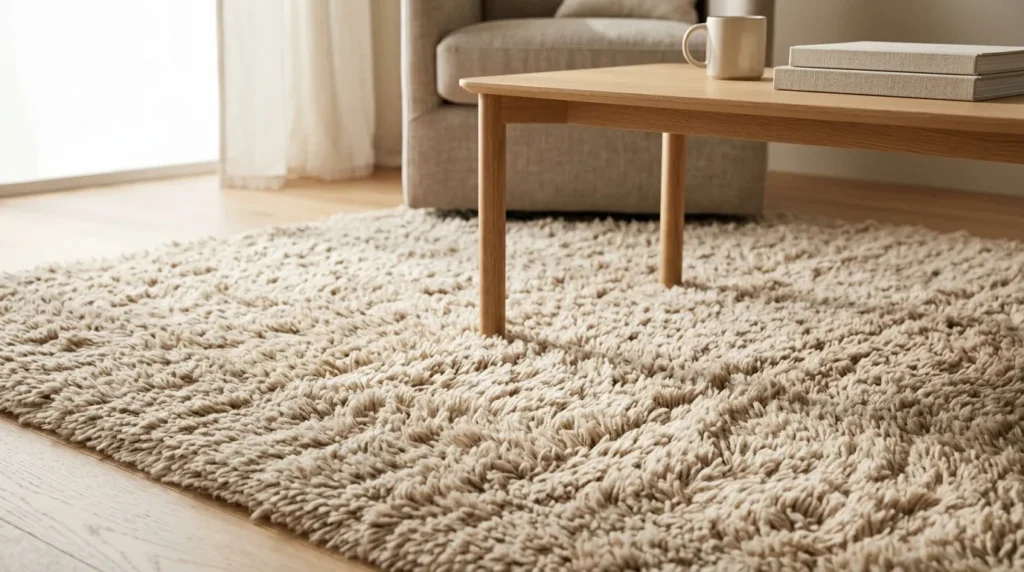
Quick Benefits
- Adds a tactile sense of luxury underfoot
- Elevates simple furniture through texture
- Anchors the seating area with visual weight
- Works across traditional and modern styles
- Improves comfort as much as appearance
Why It Works
A thin, flat rug is one of the fastest ways to make an otherwise nice room feel underwhelming. A mistake many homeowners make is prioritizing pattern over pile height and quality when rug shopping, when a plush, high-pile rug in a simple neutral tone often reads as far more expensive than a busy, thin, patterned one. This works because texture and quality are things people register instinctively, even if they can’t articulate exactly why a room feels elevated.
How To Style It
Choose a rug substantially larger than a “starter” size — at minimum, front furniture legs should rest on the rug — and prioritize a plush pile and quality material like wool over synthetic, flat-woven options if budget allows. A simple, subtly textured neutral rug will almost always read as more elegant than a busy, low-quality patterned one at the same price point.
8. Sculptural Coffee Table
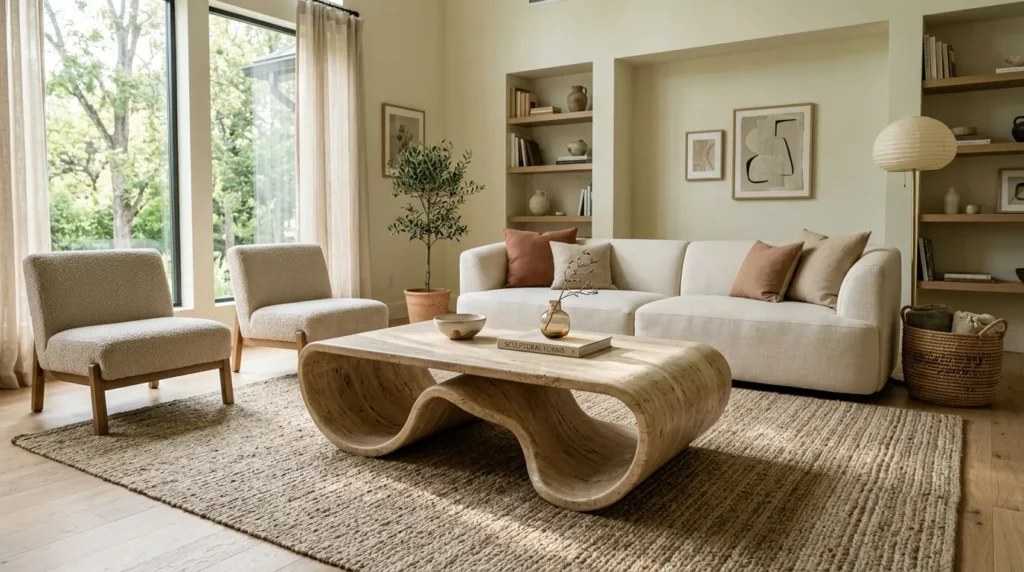
Quick Benefits
- Serves as a functional art piece
- Elevates a simple, neutral seating arrangement
- Creates a strong visual anchor for the room
- Works as a worthwhile single splurge item
- Photographs beautifully from multiple angles
Why It Works
If you’re anything like me, you’ve noticed that a plain rectangular coffee table often disappears into the background of a room, while a sculptural one — curved, organic, or with an interesting base — becomes a quiet centerpiece. This works because a distinctive coffee table sits at eye level for anyone seated, making it one of the most visually prominent pieces in the room, even more than the sofa itself in many layouts.
How To Style It
Choose one coffee table with genuine sculptural interest — a curved travertine base, an organic marble top, or an interesting mixed-material design — and let the rest of the furniture stay simple so the table remains the visual anchor. Style it sparingly, since an interesting shape needs open surface space to be fully appreciated rather than being covered in objects.
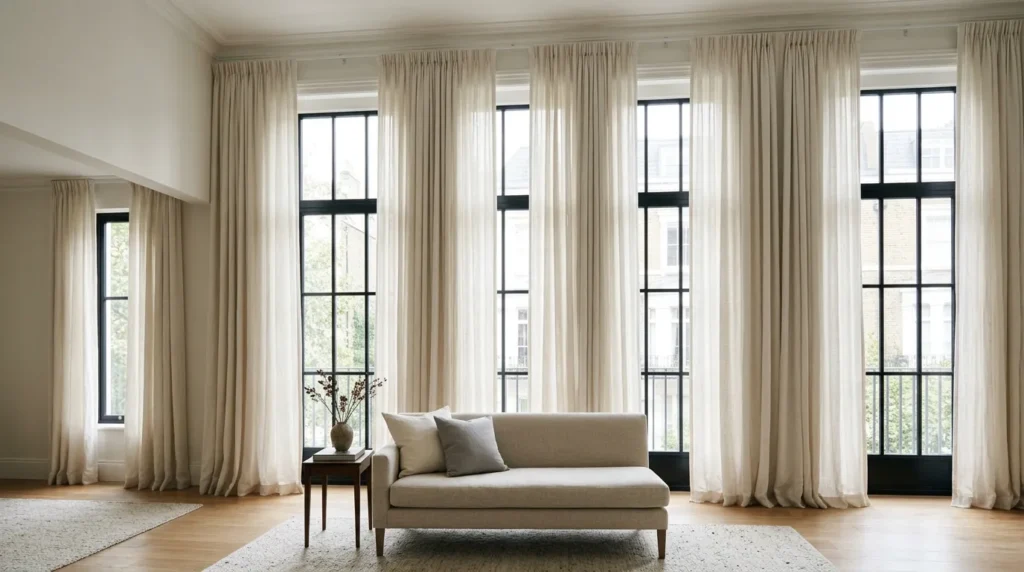
9. Floor-To-Ceiling Drapery
Quick Benefits
- Makes ceilings appear taller than they are
- Adds softness and formality to windows
- Works in nearly any room height
- Frames windows more elegantly than short curtains
- Relatively affordable compared to major renovations
Why It Works
A mistake many homeowners make is hanging curtains that stop just above the window frame, which visually shortens the wall and makes ceilings feel lower. One simple trick I always suggest is mounting curtain rods as close to the ceiling as possible and choosing drapery that falls all the way to the floor. This works because the extra height draws the eye upward, creating the illusion of a taller room — a classic technique borrowed directly from formal interior design.
How To Style It
Mount curtain rods a few inches below the ceiling rather than directly above the window frame, and choose panels long enough to just graze or gently pool at the floor. Opt for a solid, substantial fabric like linen or a heavier cotton blend rather than sheer alone for a more formal, elevated look, especially in a primary living space.
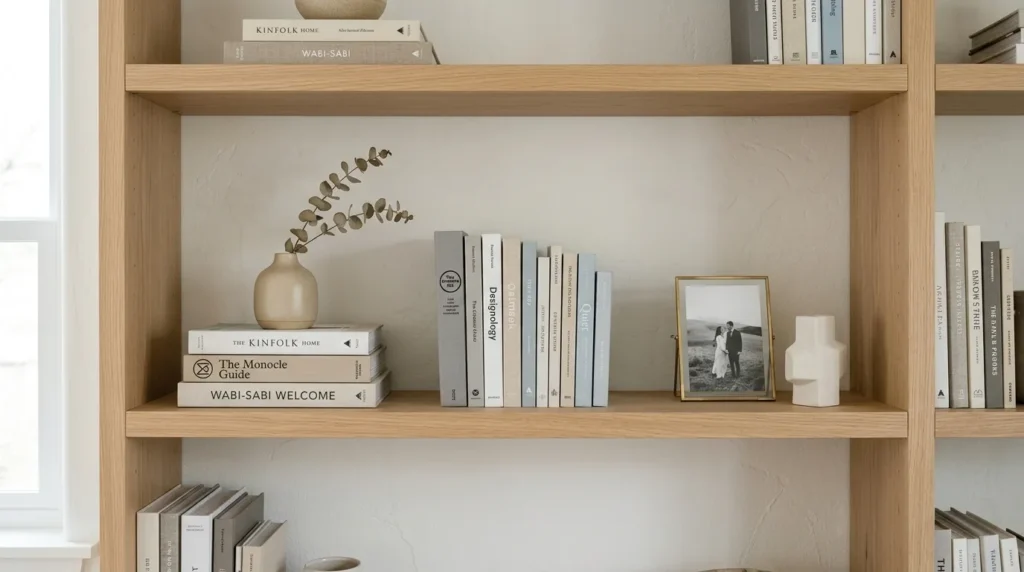
10. Curated Bookshelf Styling
Quick Benefits
- Turns a functional shelf into a design feature
- Reflects personal taste in a polished way
- Balances color, texture, and negative space
- Works in both large and small living rooms
- Easy to adjust and refresh over time
Why It Works
A shelf packed edge to edge with books, regardless of how organized, tends to look cluttered rather than curated. In my experience, the shelves that look genuinely elevated leave breathing room — books arranged both vertically and stacked horizontally, mixed with a few objects like a small vase, a piece of sculpture, or a framed photo. This works because negative space is itself a design element; a shelf with room to breathe reads as intentional, while a completely full one reads as storage rather than styling.
How To Style It
Remove roughly a third of the books from a fully packed shelf and set them aside for rotation. Mix vertical stacks with a few horizontal ones topped by a small object, and leave visible gaps of empty space throughout rather than filling every inch. Group objects by color or material family to keep the overall look cohesive rather than scattered.
Frequently Asked Questions
What’s the fastest way to make a living room look more expensive?
Tonal layered neutrals and symmetrical furniture arrangement are the fastest, lowest-cost changes. Rearranging existing furniture into a more balanced layout and simplifying the color palette can shift the entire feel of a room in an afternoon.
Do I need designer furniture to achieve an elegant look?
No. An elegant look comes more from color cohesion, texture, and thoughtful arrangement than from the price of individual pieces. A modest sofa in a well-balanced, tonal room will often look more elevated than expensive furniture placed without intention.
Is marble necessary for an elegant living room?
Not necessary, but a marble or marble-look accent — a coffee table, tray, or side table — adds a noticeable touch of polish. High-quality marble-look materials can achieve a similar effect at a lower cost than natural stone.
How important is rug quality for an elegant look?
Very important. A high-pile, quality rug in a simple neutral tone typically reads as more elegant than a busy, low-quality patterned rug, since texture and material quality are often more noticeable than the pattern itself.
Can a small living room still look elegant?
Yes. Ideas like floor-to-ceiling drapery, oversized wall art, and tonal neutrals work especially well in smaller rooms, since they create height and cohesion without requiring additional furniture or floor space.
What color palette looks the most expensive?
Tonal neutral palettes — creams, warm taupes, soft greiges — consistently read as more elevated than rooms with many competing accent colors, since they mimic the restrained, cohesive palettes used in high-end interior design.
Conclusion
An elegant, expensive-looking living room rarely comes down to spending more — it comes down to spending more thoughtfully. Tonal color palettes, rich textures like velvet, symmetrical layouts, and a few statement pieces like a sculptural coffee table or oversized art all work together to create a sense of quality and intention that a larger budget alone can’t guarantee.
Start with one or two ideas and gradually build a space that reflects your style and supports everyday comfort. Simplifying your color palette or rearranging furniture into a balanced layout costs nothing and often makes the most noticeable first difference, before moving on to bigger investments like a rug or a statement furniture piece. Give each change room to settle before adding the next, and let the room’s elevated feel build naturally over time.
Related Articles
- Cozy Living Room Ideas
- Modern Farmhouse Decor
- Neutral Home Styling
- Small Living Room Layouts
- DIY Accent Wall Ideas